Background
* NOTE: THERE IS AN NEW POST ON THIS TOPIC POST-WORKSHOP DISCUSSING THE OUTCOME *
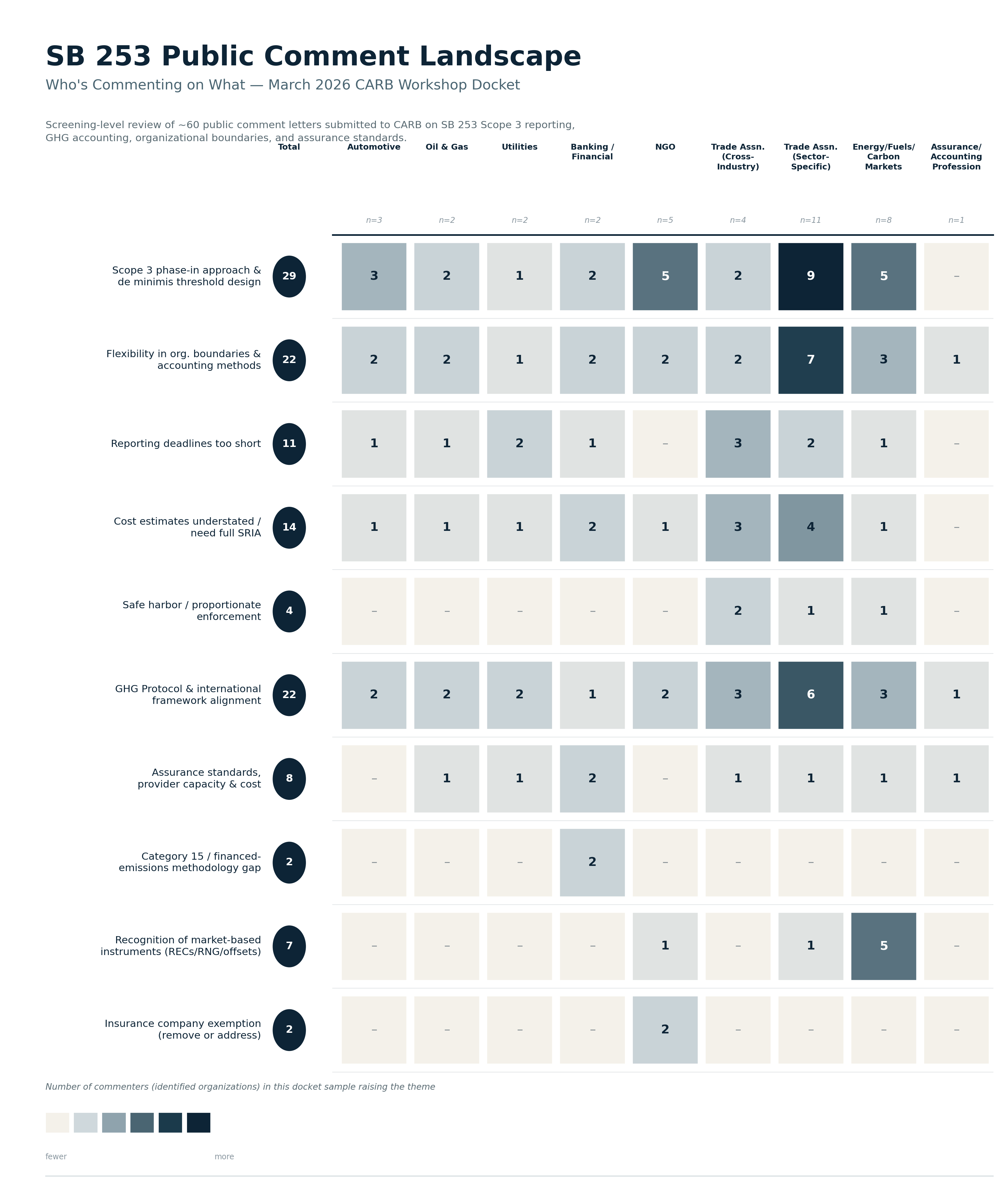
On July 21, CARB will hold its next public workshop for its rules governing the substance for disclosures later this year and for scope 3 in 2027. CARB in this next workshop is, at least in part, going to be reacting to the comments it’s received in the last workshop in March. I put together a general breakdown of the topics addressed in the comments. I tried to tease out what was of interest to which industries and what topics were of the most interest generally. The accompanying chart looks at the top 10 comments that came up. The chart gets to the level of engagement on the topic by the organizations who commented, but doesn’t show the intensity or positions (ie, comments are listed together if they touched on a topic, but may have been vastly different in substance).
Engagement
The most commented on topic under this method was the scope 3 phase-in. It had the most total comments, and almost every sector commented on it. The next two are flexibility in organizational boundaries and accounting methods (and admittedly, this is a broad topic) and GHG protocol alignment. As you would expect, these all go to the actual content of the disclosures. No surprise, I expect CARB will want to spend substantial time on these in the workshop. The fourth addresses the cost estimates from the March workshop. That again is no surprise since the cost estimates CARB used seemed both low across the board and underestimated scope 3 in particular.
The largest number of comments by topic came from trade associations. I broke these out between sector-specific and cross-industry and, taken together, they represent the most comments. This is, again, no surprise, as trade associations often represent a wide range of member companies even if they are sector-specific. Nongovernmental organizations were also prominent commenters. Many major sectors had a few commenters each, but one, insurance, had none that I identified.
Some key differences among commenters
No two comments are exactly alike, although there are some commonalities by industry. There are some key differences among the comments that are worth highlighting.
There is little dispute among comments that a scope 3 phase-in is necessary; the argument is over the appropriate phase-in mechanism (sectoral vs. category vs. broad-with-de-minimis). Within this larger debate, the de minimis threshold is the most contested issue. Some commenters, primarily NGOs, are pushing quantitative caps (a fixed percentage “budget” that can be used to exclude certain categories) versus a industry-supported broader de minimis exclusion that would be based on a reporter’s own determination of materiality, which would be subject to disclosure and assurance. However, there was one interesting industry/NGO alignment, with one industry group taking a position favoring a quantitative threshold aligned more closely with the NGO position.
Industry is split on scope 3 phase-in mechanisms. Not coincidentally, the phase-in favored by an industry tends to push that industry’s most material category out further, whether sectoral/category or broad with de minimis. One comment thread that is interesting advocates a hybrid system, with companies potentially using multiple methods based on the function and materiality.
There’s a data point worth flagging arising from CDP’s own sector-level emissions data compared with CARB’s proposal. For automakers and oil & gas companies, the “use of sold products” category (Category 11) makes up roughly 90% of total Scope 3 emissions. In my experience, for the heavy duty segment it can be even higher. For financial services, investment and lending emissions (Category 15) run over 99%. For real estate, two categories combined account for about 75%. None of those categories are on CARB’s proposed early-phase-in list from the March workshop (Option 3, CARB slide 27: Categories 1, 3, 5, 6, and 7). If CARB adopts a category-based phase-in along those lines, several of the largest sectors won’t be reporting their single most material Scope 3 category for years after the rule takes effect. That’s a real tension CARB will need to resolve if it goes for Option 3. One additional note I’ll make here is that CARB knows these sectors, in particular auto and heavy duty well since it has its own certification authority. Until earlier this year that included greenhouse gas certification. It is possible that they may try some hybrid approach, with categories of high materiality included only for certain sectors (like category 11) that might be expected to have the capability to calculate that the high materiality category.
When it comes to accounting methodology, it is safe to say that all industry commenters stress flexibility and alignment to GHG Protocol. I’ll use a comment that I filed to illustrate this. In that comment, I stressed that companies should be able to use emission factor methodologies that are aligned with their level of maturity, per their discretion. Specifically, a company that uses product-specific product carbon footprints, particularly done in alignment with a recognized standards, should be on the same page from a compliance perspective as a company that is using a spend-based average as an emission factor. Companies should be able to grow in sophistication in their methods as long as they are aligned with the GHG Protocol options or other recognized standards.
The financial sector’s comments deserve a specific mention as part of the accounting methodology debate, because they’re flagging a methodology gap. Banking commenters argued that none of the four Scope 3 accounting methods CARB floated in March (spend-based, activity-based, average-data, supplier-specific) actually work for financed or underwritten emissions, since a bank’s Category 15 footprint is really its clients’ emissions, attributed by financial relationship rather than by supply chain. They pointed to PCAF (the Partnership for Carbon Accounting Financials) as the standard built for exactly this problem.
Finally, assurance criteria, while it wasn’t high in number of comments, had a clear debate theme over the qualifications of assurers. One group of commenters argues that criteria should be applied that would effectively require certain CPA-level qualifications, like those possessed by large accounting firms, for non-CPA firms. Others argue that qualification should not be set so narrowly and that non-CPA firms should be able to qualify. It seems to me that this has large ramifications from a practical standpoint for reporting companies since they will have to find and engage assurers very quickly whatever the timeline and scope turns out to be.
What to watch for
Based on where the comments landed, here’s a few things I’ll be watching for at the workshop:
- A clearer signal on the Sc3 phase-in and de minimis mechanism. What approach, or combination, is CARB favoring? Does CARB move toward a quantitative cap, reporter-determined materiality, or some hybrid? This is the single most contested design choice in the record, and it affects nearly every other decision downstream.
- Which phase-in structure CARB favors — sectoral, category-based, or broad-with-exclusions — and whether CARB acknowledges the category-coverage gap the CDP data points to. CARB may also look to an additional option mixing these options.
- Movement on cost. Given how consistently commenters challenged CARB’s cost estimates, I’d expect at least an acknowledgment that the March numbers need revisiting.
- Whether CARB engages with the financial sector’s methodology concerns directly, or leaves Category 15 to a future workshop.
- Some signal on assurance qualifications — this wasn’t the most-commented topic, but it has the most immediate practical consequence for reporting companies, who need lead time to line up an assurance provider regardless of how the rest of the rule shakes out.
I’ll follow up with what CARB actually says on these points. Note that there should be another chance to comment either at the workshop itself or in writing afterwards. Feel free to reach out if you have any questions.
Note on methodology – This is based on a screening-level pass at approximately 60 comment letters submitted to CARB after the March workshop. As noted, it doesn’t try to get at the substance of the comments and is based on a good-faith effort to categorize the comments together. Some of the commenter categories were clear, others were less so. I did my best to choose a most reasonable category for the commenters. This analysis doesn’t try to get at the diversity of opinion, and there were very different opinions within this snapshot that are counted as comments. The total numbers in the row labels shows the number of organizations commenting on the topic, but doesn’t attempt to calculate the number of comments on the topic made by any organization or the intensity.
Leave a Reply