What happened
CARB held its latest workshop for its SB253 rule development, likely the last one prior to issuing draft rules (aside from a series of planned listening sessions), on July 21, 2026, discussing the slides posted on July 20th. CARB resolved the most significant structural question (Scope 3 phase-in) but looks to have pulled back on additional specificity in one area in particular, accounting methods. While this may leave some grey areas for reporters, it is consistent with the overall theme of this workshop: the increased emphasis on GHG Protocol (GHG-P).
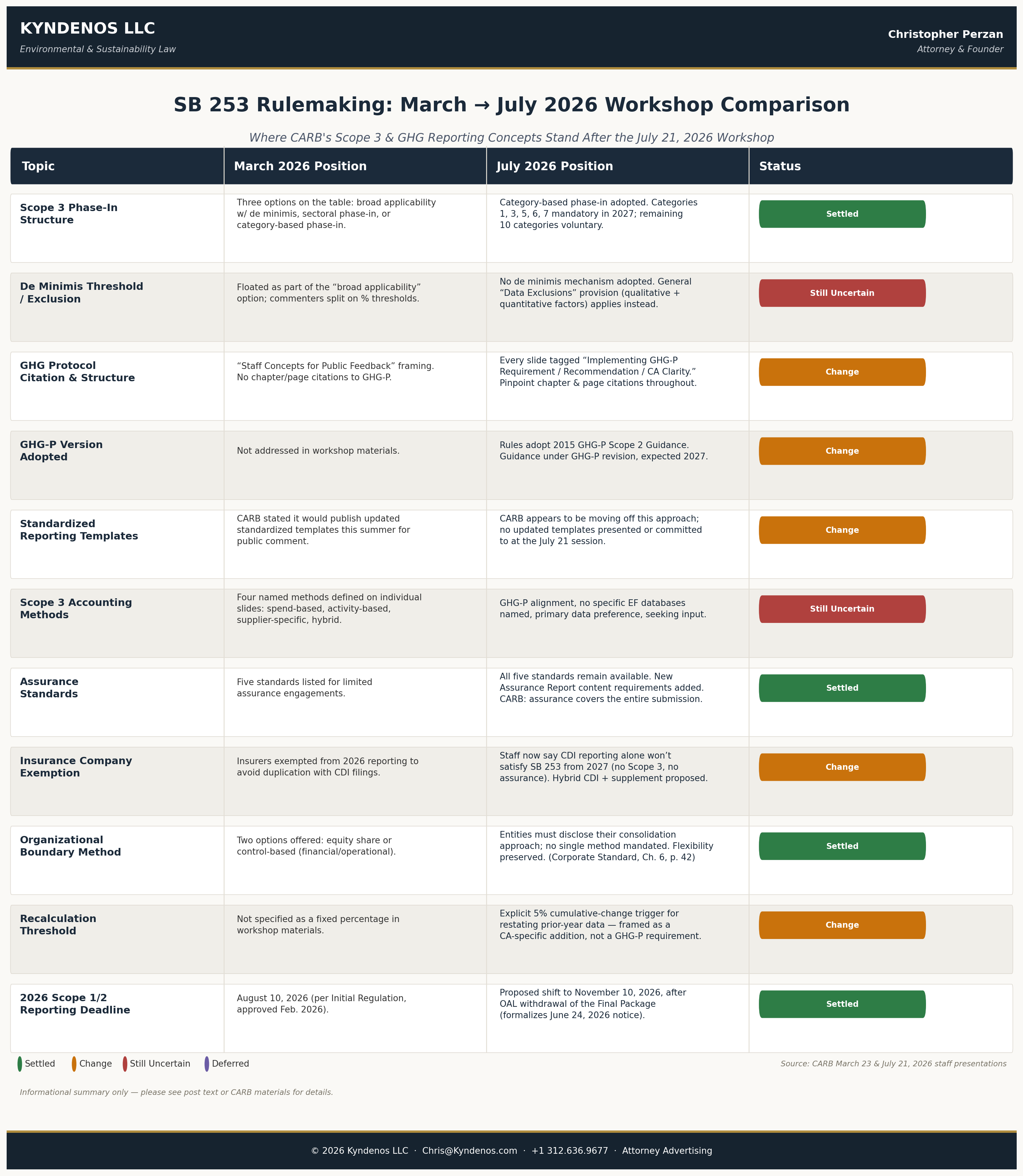
These are my in-depth thoughts from the slide presentation and the workshop. In addition, I put together a chart that shows the March position on various key topics, the position in July and the summary-level status. I categorized four issues as Settled in the chart. By “settled” in this context, I mean that CARB appeared firm in its intended path for the draft rules. New issues, or a clear change from an earlier position are labeled as Change. Finally, some issues were clearly still uncertain or deferred, and are labeled as such. In addition, an Appendix to this post has all of the questions contained in the July presentation pulled out. Those are areas where CARB is still specifically seeking guidance, highlight where uncertainties still lay and where comment will be particularly useful.
To clarify where we are with the rules: CARB, on July 27, proposed changes to the Initial Rulemaking, resetting the deadline for scope 1/2 reporting to November 10, 2026 as well as setting the fees and defining who is covered by the rule. (The November 10 deadline itself was first announced back on June 24; this is the formal regulatory text implementing that change, now open for comment.) The July 21st workshop covered different territory: the substantive requirements covering what has to be reported and how.
For the first time, we saw actual draft regulatory language, which is important to scrutinize. CARB inserted draft language into the presentation that it characterized as “potential regulatory language” (slide 10). In particular slides 12-17 & 19, 21-24, 26, 28-30, 32-34 contain these call-out boxes with what are snippets from a draft rule. Although it may well change between now and the issuance of the draft rule, it gives a clear indication of what the language may look like; and the actual regulatory language is what really matters.
These are still pre-rulemaking concepts. CARB has not committed to a release date for the formal proposed rule, which will carry its own 45-day comment period. However, in the notice and slides for this workshop CARB invited written comment on the workshop.
What We Learned
GHG Protocol alignment becomes more explicit as the organizing structure
There was a very noticeable change both in the staff presentation and throughout the oral discussion, with CARB tightly linking to GHG-P in most cases. Many of the substantive slides as well as the oral discussion were tagged to the relevant GHG-P standard and provision. Specific GHG-P Chapter-and-chapter or page citations were throughout the presentation, in contrast with March’s “Staff Concepts for Public Feedback” framing, which had no citations.
CARB stated that it will incorporate the 2015 version of the GHG-P Scope 2 Guidance specifically, by reference, and cannot build a dynamic rule that auto-updates as GHG-P revises its standards. GHG-P is mid-revision on the Scope 2 Guidance right now — a multi-year technical development process with a new standard expected in 2027, so California’s fixed 2015 reference will diverge from GHG-P at some point, at least until it conducts a specific regulatory update.
It is very well-trodden ground for an environmental agency to incorporate standards of various kinds into rules. How they do it can vary: sometimes they will just point to a standard and incorporate it, other times they may carve out exceptions for instances that do not fit with a regulatory scheme for any number of reasons. Once that is done, it is also common for agencies to update the rules regularly to incorporate updates to those standards. This can be done in an expedited manner where the update is non-controversial. The federal government often does it with a type of rule proposal that becomes effective automatically unless anyone files comments objection, known as a direct final rule; California has its own version of this. How the GHG-P is incorporated and any update procedure (which they don’t have to and probably won’t address now) is an issue to watch for once the GHG-P updates are finished.
CARB also stressed that it will promote interoperability with IFRS S2 and EU CSRD “to the greatest extent possible.” They acknowledged that this was in direct response to stakeholder feedback. It would be nice for CARB to detail what this means, for instance, if you are compliant with CSRD, are you automatically compliant with SB253? To my mind, interoperability is not necessarily the same as equivalent. Look for more clarity here.
Scope 3 phase-in: decided – Option 3 it is
CARB indicated it would propose a scope 3 requirement to start with the five most commonly reported categories (March’s “Option 3”), resolving the single biggest open question from March. The mandatory categories starting 2027 include:
- Category 1 (Purchased Goods & Services),
- Category 3 (Fuel & Energy-Related Activities),
- Category 5 (Waste),
- Category 6 (Business Travel),
- Category 7 (Employee Commuting).
The remaining 10 categories are voluntary, including Category 11 (Use of Sold Products) and Category 15 (Investments) — the largest categories for autos, oil & gas, and financial services respectively. This issue, combined with the de minimis issue discussed below, was the most common subject of comments.
This compromise may make sense from an implementation perspective. Since it captures the most commonly reported categories, presumably that eases the initial burden for many companies. Nonetheless, for companies that have never tackled category 1 and have substantial supply chains, it still can be a heavy effort. From a policy perspective, though, this approach leaves large gaps in emissions disclosures for some sectors, unless the reporters choose to report voluntarily. The transportation manufacturing sector, such as the broader automotive sector (the one which I am most personally familiar with), generally has the largest portion of overall scope 3 emissions come from use of sold products (category 11), well over 90% in many cases. This stems from the fact that, for durable products, one accounts for the lifetime emissions in the year they are sold. So, if you sell a truck in 2026, you account for the entire projected emissions over the truck’s lifetime in 2026.
This presents companies with a choice. For some companies with large emissions outside of their total scope 3, do you solely disclose the required categories? If you do the minimum necessary to satisfy California, that means your disclosures may exclude large impacts. While that may be compliant with these specific requirements, it renders a disclosure that is technically compliant but potentially misleading about the company’s actual climate footprint — a gap a sophisticated reader, investor, or regulator may notice even if California’s rule does not require you to close it. Consider the overall disclosure approach carefully if you are in this situation.
De minimis: reframed as exclusions, but very much still unclear
The question of whether there would be an exemption for de minimis emissions was a highly contested one after the March workshop. Despite that debate, no quantitative threshold or reporter-materiality standard was adopted for Scope 3 category selection. Instead, CARB cleaves closely to GHG-P.
The standard CARB proposes in the draft language is worth quoting in full:
Reporting entities may exclude GHG emissions sources, activities, Scope 3 categories, or other information where the omission, misstatement, or obscuring could not be reasonably expected to influence the decisions, assessments, or understanding of users of the disclosure regarding the reporting entity’s GHG emissions inventory, climate-related risks, opportunities, or impacts.
There is a lot in this language and reporters should be very careful about implementing. “Reasonably expected” is a legal term of art and how it is applied in a situation can vary with the context. CARB then pointed to the five principles in the GHG-P Corporate Standard as considerations to inform this judgment. These are general concepts that operate at a very high level: Relevance, Completeness, Consistency, Transparency and Accuracy. For any reporter considering this, it would be advisable to consult with legal counsel as to whether it should be used and, if so, how to use and document its use. CARB also sought specific input on this question, which is a good indication that it has not fully decided this issue yet. See Appendix A.
Accounting methods
The March workshop presentation had four named, defined methods on individual slides: spend-based, activity-based, supplier-specific, hybrid — plus a request-for-feedback slide. The deck in July collapses all of this into two slides, 12-13 and key generic draft regulatory language: “Quantification method (e.g., direct measurement or calculation-based method), including any process-specific tools or models used.” This is one place where precision moved backward relative to March, even as precision increased almost everywhere else in the deck. For instance, the March version specified emission factor databases. In this version, CARB simply specified the three standards (Corporate Standard, Scope 2 Guidance and Scope 3 Standard). As to the organizational boundary method, generally consistent with GHG-P, CARB proposed requiring disclosure of the consolidation approach used, but did not mandate an approach (equity share vs. control).
This retreat from naming specific, “approved” databases may resolve a concern raised in our April comment letter, though probably not intentionally. Our concern then was consistency across methods: if CARB names specific default databases for spend-based accounting while leaving supplier-specific or product carbon footprint (PCF) methods without equivalent recognition, that tilts the playing field toward the less rigorous method by making it the path of least resistance. By stepping back to a more generic standard — a quantification method is acceptable so long as it conforms to GHG-P — at this stage CARB appears to have put every method on equal footing instead, at least as a particular method is acceptable to CARB. PACT (the Partnership for Carbon Transparency), the leading framework for exchanging supplier-specific PCF data, is not inconsistent with GHG-P; it supplements the Scope 3 Standard with more granular, product-level methodology. Read this way, a PACT-conformant PCF should stand on the same footing as a spend-based estimate, provided both trace back to GHG-P and the reporter does the appropriate disclosures. That is a favorable reading of admittedly thin text, however. CARB also specifically asked for further input on this, see Appendix A, and this could well be refined further.
CARB then proposed regulatory language covering:
- reporting the quantification methods (slide 13),
- uncertainty reporting favoring quantitative estimation of uncertainty with qualitative acceptable where a quantitative estimation is not feasible or would impose unreasonable burden or cost (slide 14)
- missing data elements or parameters and any substitute data sources or estimation methods including the basis for selecting the approach and assumptions; CARB stressed that this was consistent with the requirements applicable to the Mandatory Reporting Regulation (a separate regulation covering large GHG sources) (slide 15)
The second element regarding measurement uncertainty is important to note in that it is making a requirement of what is a recommendation within GHG-P (termed guidance in GHG-P), but is becoming a requirement in CARB’s rule. Reporters should take note, and, even for experienced reporters, assess the degree to which they have followed the GHG-P uncertainty guidance previously. GHG-P itself notes the difficulty of conducting uncertainty analyses and that for some aspects “companies will usually have to rely on expert judgment.”
In addition, there was a new 5% cumulative-change threshold for triggering recalculation of prior-year data — explicitly framed as a California-specific addition, not a GHG-P requirement. (Slide 22) This is a notable change from GHG-P, which contains no specific number triggering a recalculation for base year in the GHG-P Corporate Standard, instead requiring companies to adopt a policy for base year recalculations and identification of any triggering significance threshold. (CARB considers base year to be the first year of reporting.) Notably, in the guidance that further discusses recalculation in several contexts, GHG-P actually points to the California Climate Action Registry change threshold of 10% of base year emissions, but does not require any specific threshold. See Corporate Standard at page 37. Nonetheless, 5% is the recalculation threshold required in the Science Based Targets Initiative corporate net zero standard and is widely used as a significance threshold by companies with and without SBTi targets. This then, is a change from GHG-P to keep track of, but a practice which many companies already implement.
CARB called out the GHG-P methods for biogenic emissions specifically in requiring those to be reported separately from the scope 1, 2 and 3 emissions. For companies that may already be reporting their biogenic emissions under separate California laws, those may be reported in alignment with those programs as long as that is disclosed. Similarly, for companies reporting in alignment with other requirements, they may report aligned with those requirements with disclosure. These emissions are subject to assurance. In response to a question, CARB noted that conformance with GHG-P’s new Land Sector and Removals standard (effective 1/1/2027) would be voluntary, but that a reporter should clearly disclose the standard used.
CARB also includes proposed language covering reporting of voluntary investments, management activities or other practices that result in fossil or biogenic emissions reductions or removals. Note that the draft language clearly says “may” which seemingly indicates that it is up to the reporter whether or not to include these. It cites various parts of the GHG-P corporate standard for this. (Slide 17).
How CARB implements all this will be key. If this language is adopted as written, in general it is landing on more flexibility (with a few exceptions discussed that appears to go beyond what GHG-P requires in the California context). Thoroughly documenting the choices a reporter makes, and how they align with GHG-P and these rules will be critical.
Standardized reporting templates
In March, CARB indicated it would publish updated standardized reporting templates this summer for public comment. In response to a direct question at the July workshop, CARB said draft templates (originally posted in October 2025) would be voluntary rather than mandatory, and pointed reporters back to GHG-P standards generally rather than a CARB-specific format. This appears to be a resolved issue at least for the 2026 reporting period not open — reporters should not expect a mandated standardized CARB template.
Insurance exemption
The Initial Regulation (Feb. 2026) exempted insurers from 2026 reporting to avoid duplication with California Department of Insurance (CDI) filings. Staff now acknowledge CDI reporting alone likely won’t satisfy SB 253 starting 2027 (no Scope 3, no assurance). They proposed a hybrid approach — insurers may submit the CDI report if it meets CARB requirements, supplementing where it falls short.
Assurance
CARB provided draft regulatory language identifying five standards against one of which assurance must be performed. (Slide 33) CARB provided a new formal Assurance Report content-requirements slide (provider identity, conclusion, standard applied, dates) — not present in March. In response to a question, CARB indicated the limited assurance requirement will apply to the entire submission, not solely the Scope 1/2 emissions totals. CARB particularly noted that this included both quantitative and qualitative elements in the submissions. At the workshop, they orally asked for feedback on whether the results would be comparable under the five standards proposed and whether there should be a rotation requirement for assurers and the disclosure of other services.
Particularly with regard to the optional reporting elements (very much including emission reductions or removals) — it is worth considering what “entire submission” covers before finalizing assurance engagement scopes and how CARB will look at this. This is particularly important to consider in the context of areas like emission removals.
What’s Still Unknown
- Timing for phase-in of the remaining 10 Scope 3 categories — CARB was asked directly and declined to answer.
- Updated cost figures — methodology described, numbers not yet republished.
- Exact scope of “entire submission” for assurance purposes — stated live, not yet defined in writing.
- Exact timing of the formal proposed rule language — CARB has not committed to a release date.
What’s Next
- CARB stated in the notice and slide deck for this that they will accept written feedback. There is no formal comment period, however.
- CARB will hold six “listening sessions” between August 5 and September 9. CARB stated explicitly that the August–September sessions are for CARB to gather feedback, not to share new information. However, any feedback now is critical, particularly since the regulatory language itself is starting to form. The more specific on any comments, the better.
- CARB did state that it intended to provide additional guidance prior to the November 10, reporting deadline, including a voluntary intake platform for fee contact information and GHG emissions reporting, a guidance document and instructional video.
- CARB started a 15 day notice period for the changes to the Initial Regulation, beginning on July 27 with comments due August 11, 2026.
Practical Takeaways for Companies
- Consider carefully how to use the flexibilities in the potential rules. Consider your overall disclosure framework as a whole.
- Companies already reporting under GHG-P internationally, or under CSRD/ISSB frameworks that track current GHG-P guidance, should watch for eventual divergence between California’s fixed-version incorporation and whatever GHG-P adopts next, in particular for scope 2.
- Financial institutions get a real reprieve on Category 15 timing but should watch the September 9 listening session closely.
- Insurance companies: CDI reporting alone likely not sufficient starting 2027; a supplement may be necessary.
This analysis does not contain all of the information at the workshop, but has been synthesized as a summary. It doesn’t capture all of the variations that may apply to a specific situation and is, as such, general information and not legal advice. As always, I will be following this closely and am available to assist.
Appendix A: All Discussion Questions Posed in the July 21, 2026 Staff Presentation
The following questions appear verbatim in the July 21, 2026 CARB staff presentation, in the order presented. Slide references are to the PDF as posted at the CARB workshop website July 20, 2026.
General Requirements (Slide 11)
- Do the proposed requirements offer adequate clarity for Greenhouse Gas Protocol aligned reporting? Are there topics that need additional clarification or specificity in regulation requirements?
Primary Data Prioritization Guidance (Slide 18)
- Are there cases when CARB should encourage or require the prioritization of specific measurement approaches, emission factors or quantification methods? If so, what approach could support scientific best practices, while offering adequate flexibility when higher-quality data are limited or unavailable?
- Are there sector- or source-specific quantification methodologies or standards CARB should consider recommending in follow-up guidance documents?
Data Exclusions Discussion (Slide 20)
- Are the proposed factors appropriate and sufficient for considering acceptable exclusions from GHG emission inventories?
- What further direction may be needed for reporting entities to consider data exclusions in a consistent and comparable way?
- Does the proposed approach balance reporting burden with the objective of providing complete and decision-useful emissions information?
Economic Analysis (Slide 40)
- What cost changes does your business anticipate from making climate disclosures?
- What benefits does your business or organization anticipate from climate-related disclosures?
Leave a Reply